Toggle light / dark theme

Nikon, Sony and Canon fight AI fakes with new camera tech

TOKYO — Nikon, Sony Group and Canon are developing camera technology that embeds digital signatures in images so that they can be distinguished from increasingly sophisticated fakes.

Nikon will offer mirrorless cameras with authentication technology for photojournalists and other professionals. The tamper-resistant digital signatures will include such information as date, time, location and photographer.

Quantum Key Distribution for Secure Optical Communication

In the modern digital age, where data flows freely and sensitive information is constantly in transit, secure communication has become essential. Traditional encryption methods, while effective, are not immune to the evolving threat landscape. This is where quantum key distribution (QKD) emerges as a revolutionary solution, offering unmatched security for transmitting sensitive data.

Image Credit: asharkyu/Shutterstock.com

The idea of quantum key distribution (QKD) dates back to Stephen Wiesner’s concept of quantum conjugate coding at Columbia University in the 1970s. Charles H. Bennett later built on this idea, introducing the first QKD protocol, BB84, in the 1980s, using nonorthogonal states. Since then, it has matured into one of the most established quantum technologies, commercially available for over 15 years.

Aerogel could become the key to future terahertz technologies

High-frequency terahertz waves have great potential for a number of applications including next-generation medical imaging and communication. Researchers at Linköping University, Sweden, have shown, in a study published in the journal Advanced Science, that the transmission of terahertz light through an aerogel made of cellulose and a conducting polymer can be tuned. This is an important step to unlock more applications for terahertz waves.

The covers wavelengths that lie between microwaves and infrared light on the . It has a very high frequency. Thanks to this, many researchers believe that the terahertz range has great potential for use in , security technology and communication systems, among other things.

In , it can also be an interesting substitute for X-ray examinations as the waves can pass through most non-conductive materials without damaging any tissue.

Rocket Lab wins $515 million contract to build 18 satellites for U.S. government agency

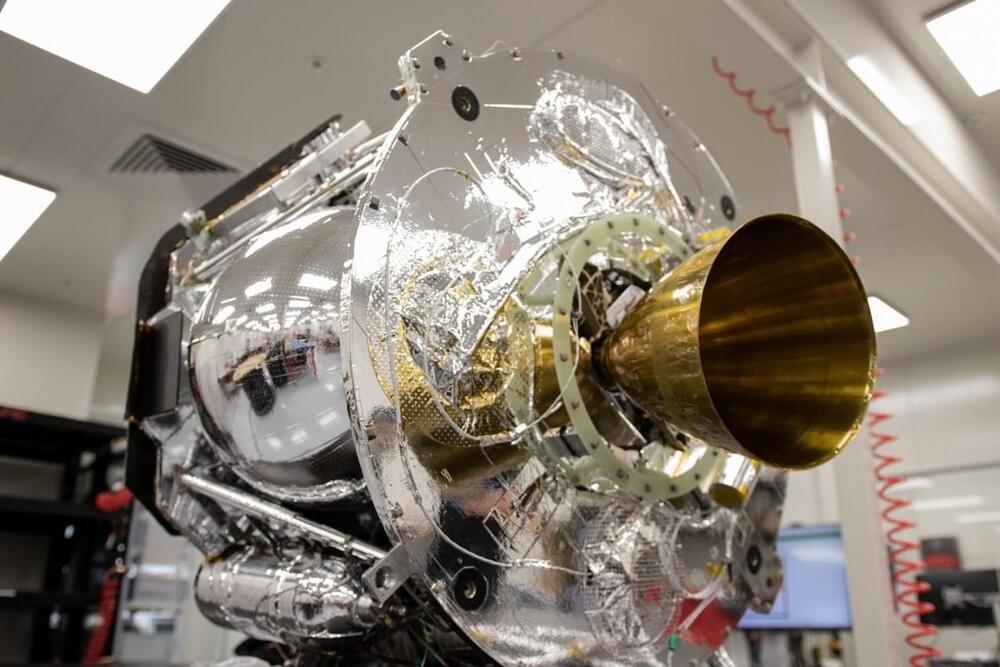
WASHINGTON — Space launch provider and satellite manufacturer Rocket Lab has secured a deal worth over half a billion dollars to build 18 satellites for a U.S. government agency.

As disclosed in an SEC regulatory filing Dec. 21, Rocket Lab National Security will “design, manufacture, deliver and operate 18 space vehicles” as part of a U.S. government contract valued at $515 million. A spokesperson said the company could not provide further details.

Sources indicate that the customer is likely the Space Development Agency.

World’s largest electric cable close to power, could light 1.4 million homes

A high voltage direct current cable will connect UK homes with fresh green energy from the wind farms of Denmark.


Viking Link, the world’s largest interconnector, connecting electrical grids in Denmark and the UK using a 475-mile (765 km) undersea cable is days away from being put into operation. The interconnector will go online at reduced capacity and eventually power 1.4 million homes in the UK.

Interconnectors enable a quick way to tide over demand-supply fluctuations in an electrical grid. These are especially important in a world where energy comes from renewable sources and is known to be produced intermittently. This is why the EU expects them to play a crucial role in the region’s energy security in the future.

‘Teleporting’ images across a network securely using only light

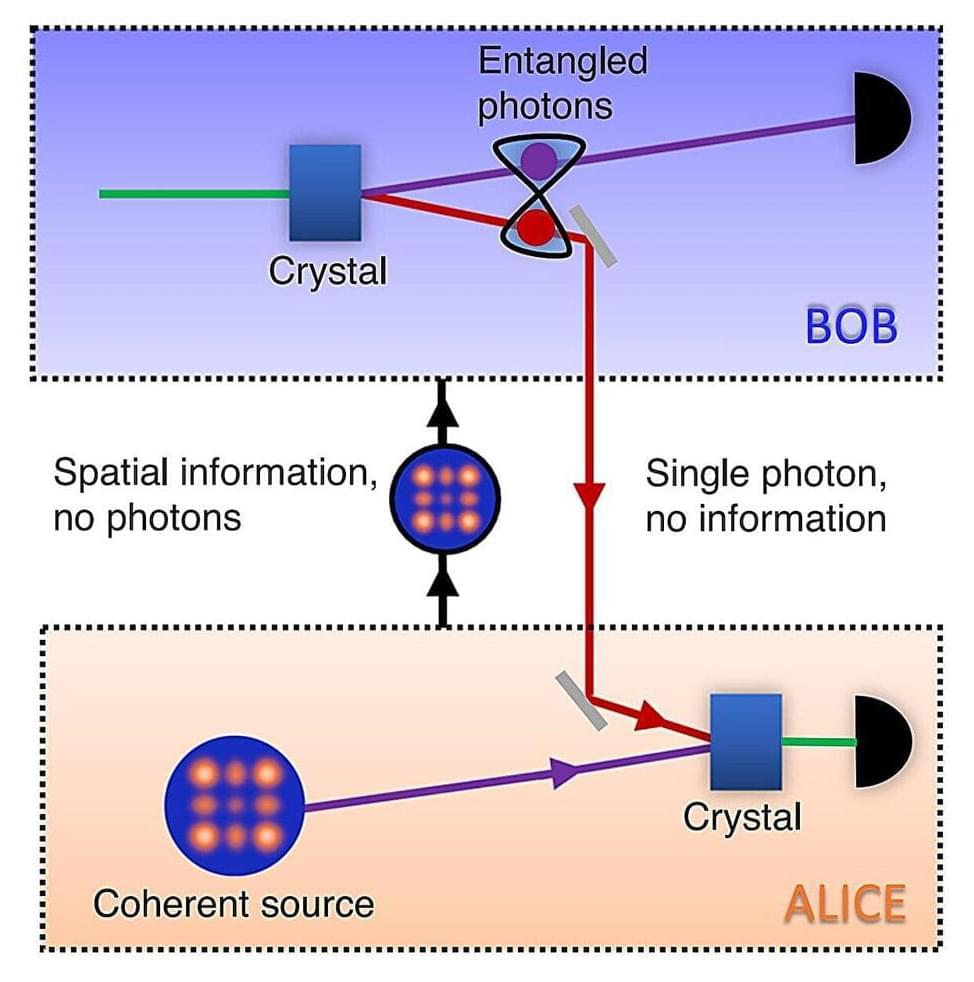
Nature Communications published research by an international team from Wits and ICFO-The Institute of Photonic Sciences, which demonstrates the teleportation-like transport of “patterns” of light—this is the first approach that can transport images across a network without physically sending the image and a crucial step towards realizing a quantum network for high-dimensional entangled states.

Quantum communication over long distances is integral to and has been demonstrated with two-dimensional states (qubits) over very long distances between satellites. This may seem enough if we compare it with its classical counterpart, i.e., sending bits that can be encoded in 1s (signal) and 0s (no signal), one at a time.

However, quantum optics allow us to increase the alphabet and to securely describe more in a single shot, such as a unique fingerprint or a face.

US firm unveils 5th-gen security robots trained on 2.5 million field hours

Over the past 8.5 years, its predecessor, the K5, has successfully patrolled diverse locations across the US, contributing significantly to crime reduction and ensuring safety in various environments, claims the firm.


Knightscope, a prominent developer of autonomous security robots, has officially commenced the shipment of its highly anticipated 5th Generation K5 Autonomous Security Robot (ASR), the company announced in a press release.

This represents a significant milestone for the company and marks a thorough redesign to elevate the flagship ASR’s capabilities. Production is in full swing at Knightscope’s Silicon Valley Headquarters. It is proudly made in America, with machines ready to fulfill nationwide contracts.

Innovations with over 2.5 million hours of field operations

The K5v5 boasts a ground-up design, informed by over 2.5 million hours of field operations, delivering tangible results for real clients. Notable enhancements include a wider stance for a more stable propulsion system, raised camera elevation enabling near eye-level 4K video capture, a revamped battery architecture for improved performance, upgraded audio capabilities for broadcast messages, intercom, and public address, enhanced nighttime visibility with additional lighting, and a significant reduction in part count and assembly time. The redesign prioritizes serviceability and maintenance, ensuring seamless operation for clients.


Robot dogs and AI inspectors prepare to transform US border security

US Customs and Border Protection (CBP) recently awarded Pangiam, a leading trade and travel technology company, a prime contract for developing and implementing Anomaly Detection Algorithms (ADA).

Pangiam, in collaboration with West Virginia University, aims to bring cutting-edge artificial intelligence (AI), computer vision, and machine learning expertise to enhance CBP’s border and national security missions, the company announced in a press release.

The Emergence Of Smart Cities In The Digital Era

By Chuck Brooks


Realizing the potential of Smart Cities will require public-private cooperation and security by design.

The idea of smart cities is starting to take shape as the digital era develops. A city that has developed a public-private infrastructure to support waste management, energy, transportation, water resources, smart building technology, sustainability, security operations and citizen services is referred to as a “smart city”. Realizing the potential of Smart Cities will require public-private cooperation and security by design.

A smart city functions as an applied innovation lab. Automation, robotics, enabling nanotechnologies, artificial intelligence (human/computer interface), printed electronics and photovoltaics, wearables (flexible electronics), and information technologies like real-time and predictive analytics, super-computing, 5G wireless networks, secure cloud computing, mobile devices, and virtualization are a few of the fascinating technological trends of the digital era that are influencing the development of smart cities.

/* */