Toggle light / dark theme

Ultrathin films of ferromagnetic oxide reveal a hidden Hall effect mechanism

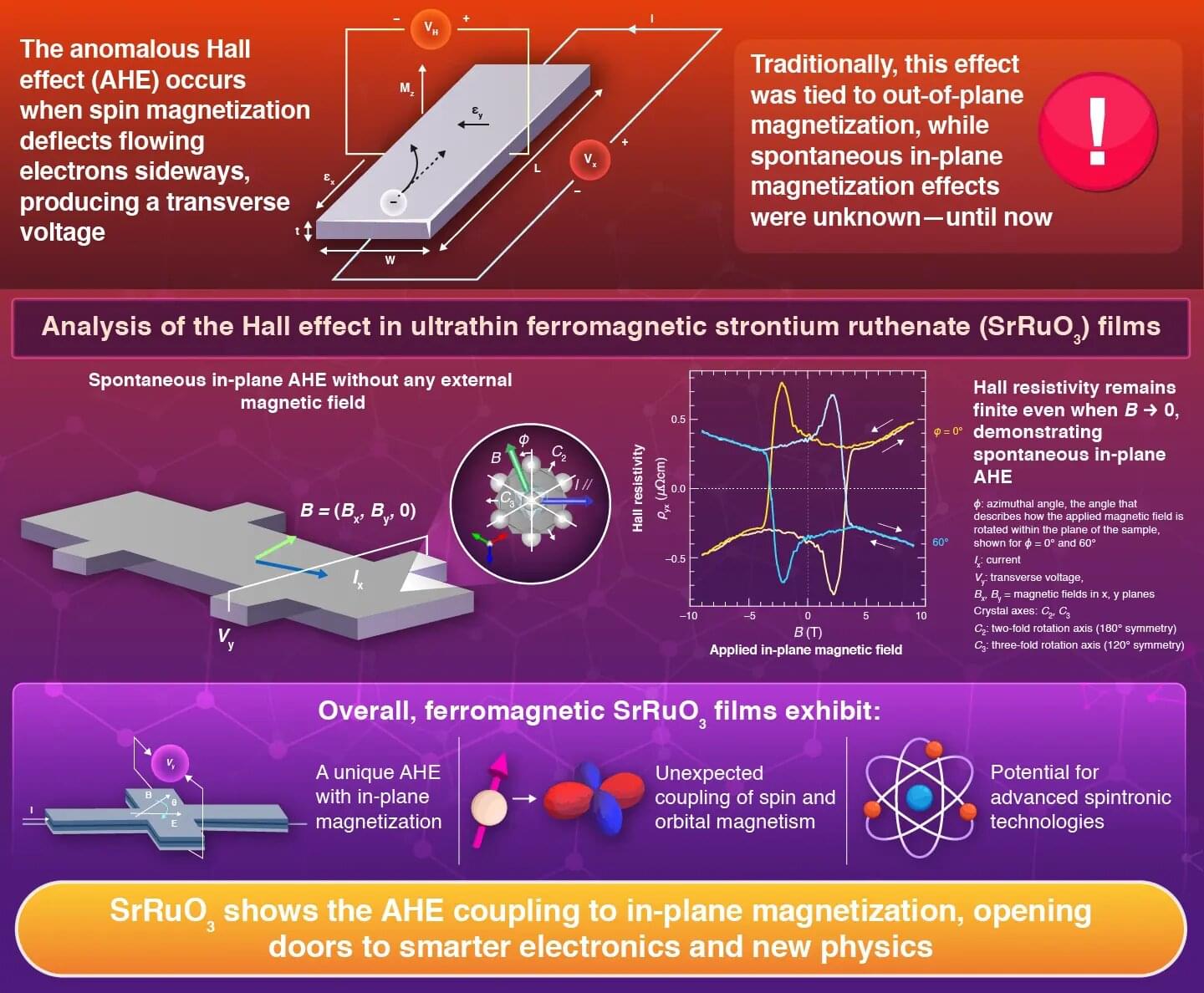
Researchers from Japan have discovered a unique Hall effect resulting from deflection of electrons due to “in-plane magnetization” of ferromagnetic oxide films (SrRuO3). Arising from the spontaneous coupling of spin-orbit magnetization within SrRuO3 films, the effect overturns the century-old assumption that only out-of-plane magnetization can trigger the Hall effect.

The study, now published in Advanced Materials, offers a new way to manipulate with potential applications in advanced sensors, , and spintronic technologies.

When an electric current flows through a material in the presence of a magnetic field, its electrons experience a subtle sideways force which deflects their path. This effect of electron deflection is called the Hall effect—a phenomenon that lies at the heart of modern sensors and electronic devices. When this effect results from internal magnetization of the conducting material, it is called “anomalous Hall effect (AHE).”

Machine learning unravels quantum atomic vibrations in materials

Caltech scientists have developed an artificial intelligence (AI)–based method that dramatically speeds up calculations of the quantum interactions that take place in materials. In new work, the group focuses on interactions among atomic vibrations, or phonons—interactions that govern a wide range of material properties, including heat transport, thermal expansion, and phase transitions. The new machine learning approach could be extended to compute all quantum interactions, potentially enabling encyclopedic knowledge about how particles and excitations behave in materials.

Scientists like Marco Bernardi, professor of applied physics, physics, and at Caltech, and his graduate student Yao Luo (MS ‘24) have been trying to find ways to speed up the gargantuan calculations required to understand such particle interactions from first principles in real materials—that is, beginning with only a material’s atomic structure and the laws of quantum mechanics.

Last year, Bernardi and Luo developed a data-driven method based on a technique called singular value decomposition (SVD) to simplify the enormous mathematical matrices scientists use to represent the interactions between electrons and phonons in a material.

Machine learning and quantum chemistry unite to simulate catalyst dynamics

Catalysts play an indispensable role in modern manufacturing. More than 80% of all manufactured products, from pharmaceuticals to plastics, rely on catalytic processes at some stage of production. Transition metals, in particular, stand out as highly effective catalysts because their partially filled d-orbitals allow them to easily exchange electrons with other molecules. This very property, however, makes them challenging to model accurately, requiring precise descriptions of their electronic structure.

Designing efficient transition-metal catalysts that can perform under realistic conditions requires more than a static snapshot of a reaction. Instead, we need to capture the dynamic picture—how molecules move and interact at different temperatures and pressures, where atomic motion fundamentally shapes catalytic performance.

To meet this challenge, the lab of Prof. Laura Gagliardi at the University of Chicago Pritzker School of Molecular Engineering (UChicago PME) and Chemistry Department has developed a powerful new tool that harnesses electronic structure theories and machine learning to simulate transition metal catalytic dynamics with both accuracy and speed.

/* */