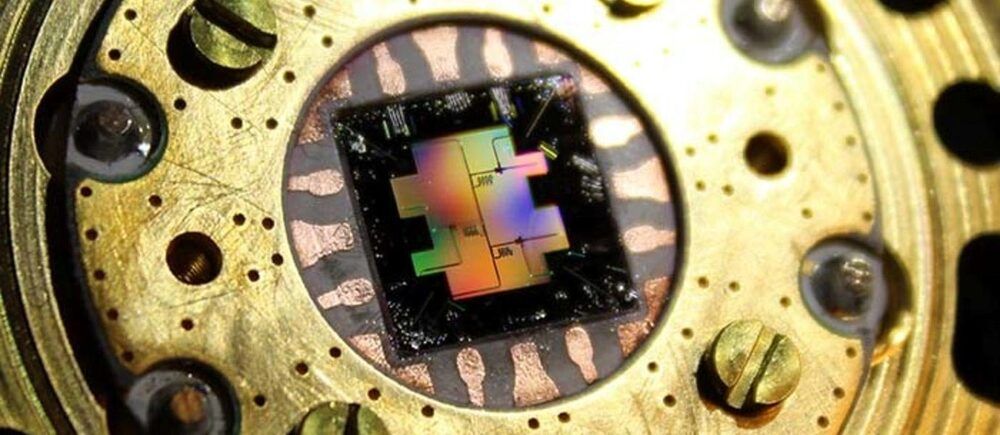
D-Wave Systems Inc. today published a milestone study in collaboration with scientists at Google, demonstrating a computational performance advantage, increasing with both simulation size and problem hardness, to over 3 million times that of corresponding classical methods. Notably, this work was achieved on a practical application with real-world implications, simulating the topological phenomena behind the 2016 Nobel Prize in Physics. This performance advantage, exhibited in a complex quantum simulation of materials, is a meaningful step in the journey toward applications advantage in quantum computing.
Category: quantum physics – Page 777


Counter-Intuitive Quantum Mechanics: State of Vibration That Exists Simultaneously at Two Different Times
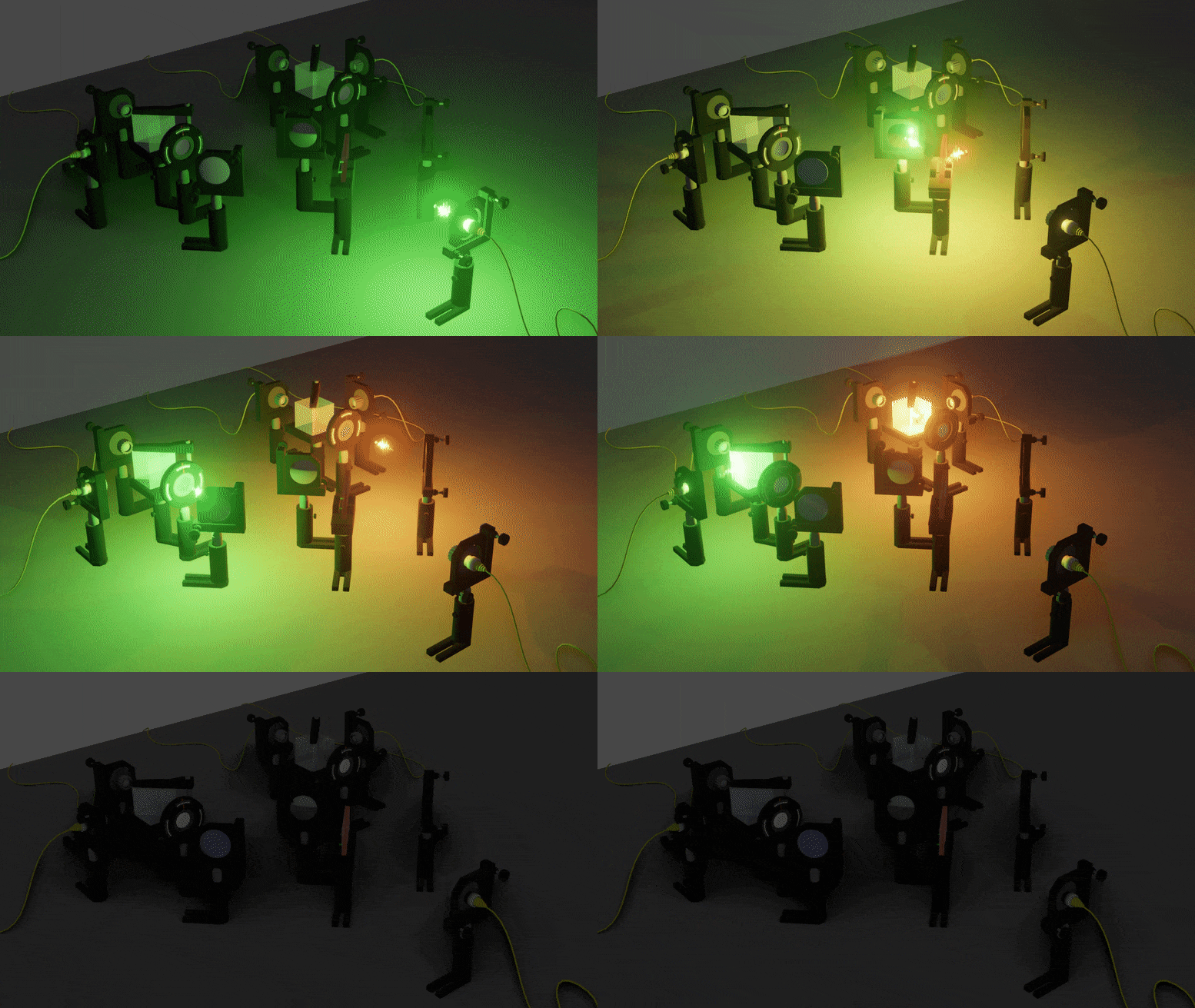
When Light and Atoms Share a Common Vibe
An especially counter-intuitive feature of quantum mechanics is that a single event can exist in a state of superposition — happening both here and there, or both today and tomorrow.
Such superpositions are hard to create, as they are destroyed if any kind of information about the place and time of the event leaks into the surrounding — and even if nobody actually records this information. But when superpositions do occur, they lead to observations that are very different from that of classical physics, questioning down to our very understanding of space and time.
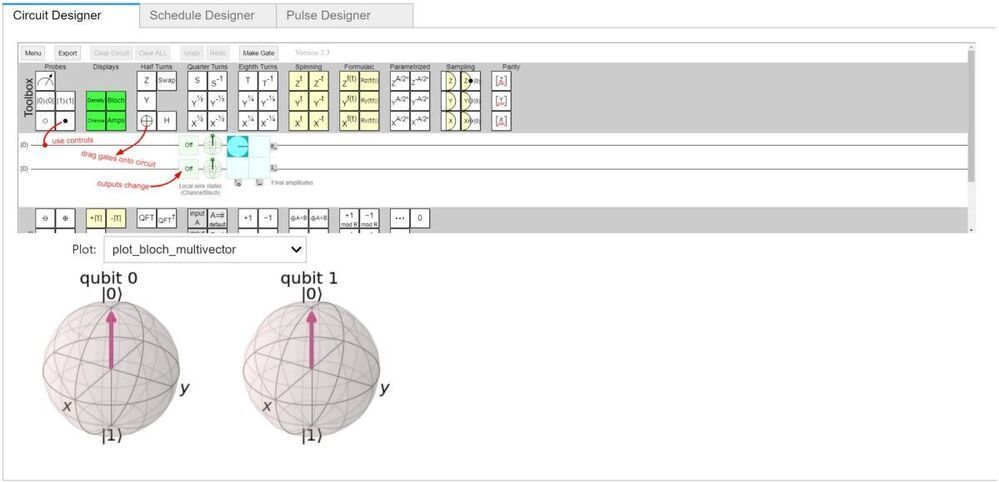
I’ve Worked in Game Development My Whole Career — Here’s Why I’m Learning Quantum Computing
Like.
By Amir Ebrahimi — Principal Software Engineer · Unity Technologies
What opened quantum computing up for me was realizing that it’s even more connected to our physical universe than classical computing is.
I’m at Unity, where I have a day job developing software for Barracuda, our CPU/GPU optimized inference engine for neural networks. I’ve been working in the video game industry since 2003, which is usually on the cutting edge of technology, so it’s surprising that I had never heard about quantum computing until about three years ago — I don’t know if I was ignoring it or if I simply wasn’t exposed to it. Back in 2018, one of my coworkers who was already interested in quantum computing shared a few links to the IBM Quantum Experience, and explained that you could use a quantum computer online. I took a look and bookmarked it, but didn’t actually try it out.
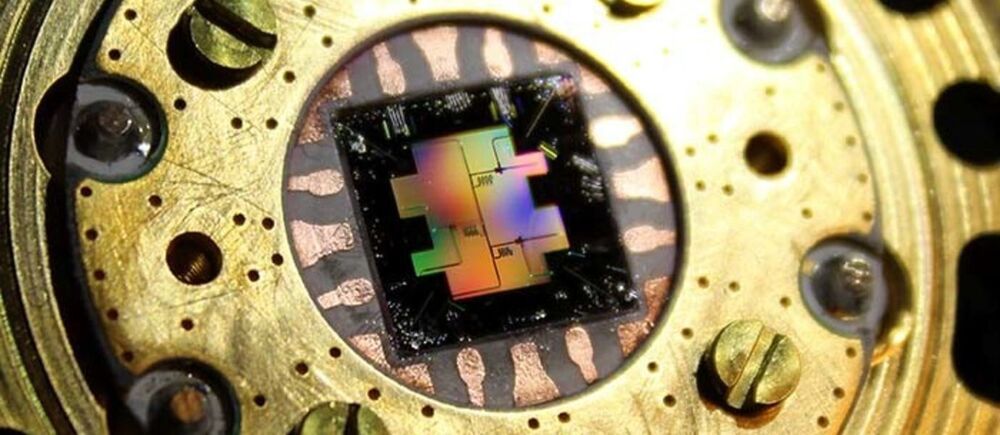
BP Ties Up With IBM’s Quantum Network
IBM announced that global energy company BP has joined the tech giant’s quantum network as an industry partner to boost the use of quantum computing in the energy industry.

Light and a Single Electron Used to Detect Quantum Information Stored in 100,000 Nuclear Quantum Bits
Researchers unlocked the electronic properties of graphene by folding the material like origami paper.
Researchers have found a way to use light and a single electron to communicate with a cloud of quantum bits and sense their behavior, making it possible to detect a single quantum bit in a dense cloud.
The researchers, from the University of Cambridge, were able to inject a ‘needle’ of highly fragile quantum information in a ‘haystack’ of 100000 nuclei. Using lasers to control an electron, the researchers could then use that electron to control the behavior of the haystack, making it easier to find the needle. They were able to detect the ‘needle’ with a precision of 1.9 parts per million: high enough to detect a single quantum bit in this large ensemble.
The technique makes it possible to send highly fragile quantum information optically to a nuclear system for storage, and to verify its imprint with minimal disturbance, an important step in the development of a quantum internet based on quantum light sources. The results are reported in the journal Nature Physics.