Toggle light / dark theme

Extreme lifespan multiomics

Recent studies suggest that the steady rise in life expectancy observed over the past 200 years has now stagnated. Data indicate that a limit has been reached, and that medical and healthcare advances no longer affect longevity in developed countries as they did in previous decades. Today, ageing itself, rather than disease, is the real frontier of human longevity. But what exactly is ageing? And can it be addressed in the same way as a disease?

A research team has just published the final peer-reviewed data from the study of the longest-lived person ever recorded, who far exceeded 117 years: the Catalan woman Maria Branyas. The analysis, based on samples obtained using minimally invasive techniques, takes a multi-omic approach with genomic, proteomic, epigenomic, metabolomic and microbiomic technologies, and represents the most exhaustive study ever undertaken on a supercentenarian.

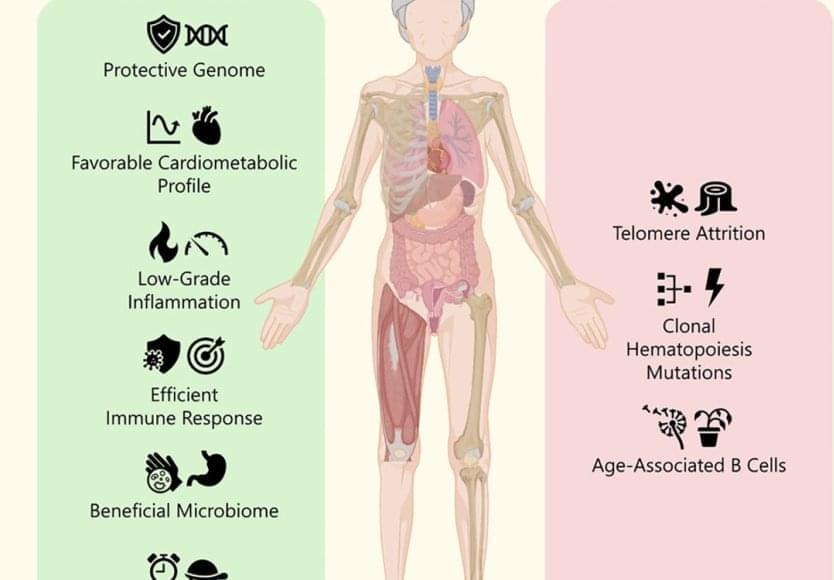
In the paper, published in the prestigious journal Cell Reports Medicine, the international and multidisciplinary team explains that individuals who reach supercentenarian age do not do so through a general delay in ageing but, as the author notes, thanks to a “fascinating duality: the simultaneous presence of signals of extreme ageing and of healthy longevity.”


Reprogramming cellular senescence and aging clocks for advanced cancer immunotherapy

Cellular senescence has gradually been recognized as a key process, which not only inhibits the occurrence of early tumors but also promotes advanced malignant progression through secretory and immunomodulatory functions. Initially, cellular senescence manifested as irreversible cell cycle arrest, but now it encompasses a broader phenotype regulated by the p53-p21CIP1 and p16INK4A-Rb pathways. Although secretory phenotypes related to aging can recruit immune effectors to clear new tumor cells, persistent senescent cell populations often trigger chronic inflammation, promoting immune escape and fibrosis. In this review, we first discuss the molecular underpinnings of cellular senescence, highlighting its induction pathways and diverse physiological or pathological roles. We then examine the composition of the tumor microenvironment, where senescent cells accumulate and secrete pro-inflammatory cytokines, reshaping immune surveillance and extracellular matrix architecture. Against this backdrop, we explore how aging clocks refine our understanding of individual susceptibility to malignancy by distinguishing biological from chronological aging. We also present current therapeutic prospects, including senolytic agents targeting senescent stromal cells that promote tumor growth, and the utilization of aging clock metrics to tailor immunotherapies more effectively for older patients. Finally, we consider the major challenges facing clinical translation, from standardizing multi-omics data pipelines to clarifying the ethical implications of measuring biological age. By bridging senescence biology with geroscience and cutting-edge oncology, we posit that aging clocks may catalyze a transformation in cancer care, enabling more personalized, effective, and age-conscious treatment strategies.

Fine Particulate (PM2.5) Exposure Negatively Impacts Hallmarks Of Aging: What’s Optimal?

Join us on Patreon! https://www.patreon.com/MichaelLustgartenPhD

Discount Links/Affiliates:
Blood testing (where I get the majority of my labs): https://www.ultalabtests.com/partners/michaellustgarten.

At-Home Metabolomics: https://www.iollo.com?ref=michael-lustgarten.
Use Code: CONQUERAGING At Checkout.

Clearly Filtered Water Filter: https://get.aspr.app/SHoPY

Epigenetic, Telomere Testing: https://trudiagnostic.com/?irclickid=U-s3Ii2r7xyIU-LSYLyQdQ6…M0&irgwc=1
Use Code: CONQUERAGING

NAD+ Quantification: https://www.jinfiniti.com/intracellular-nad-test/

Brain shape changes could offer early warning signs of dementia

A new study led by University of California, Irvine’s Center for the Neurobiology of Learning and Memory researchers found that aging changes the brain’s overall shape in measurable ways. Instead of focusing only on the size of specific regions, the team used a new analytic method to see how the brain’s form shifts and distorts over time.

The analysis revealed substantial alterations in brain shape, which were closely associated with declines in memory, reasoning and other cognitive functions. This suggests that the shape of the brain can serve as a reliable indicator of its overall health. The study appears in Nature Communications.

“Most studies of brain aging focus on how much tissue is lost in different regions,” said Niels Janssen, Ph.D., senior author and professor at Universidad de La Laguna in Spain and visiting faculty at the CNLM. “What we found is that the overall shape of the brain shifts in systematic ways, and those shifts are closely tied to whether someone shows cognitive impairment.”

/* */