Toggle light / dark theme

How China plans to win the future with its own international tech standards

China may have missed out on the opportunity to shape standards in the past, but it is quickly dominating fields that could drive the next industrial revolution, such as consumer internet, automation and green technology.


International technology standards are one reason for the West’s dominance over the last two centuries. China now has a plan for how to get the world to follow its rules.

Silicon chips combine light and ultrasound for better signal processing

The continued growth of wireless and cellular data traffic relies heavily on light waves. Microwave photonics is the field of technology that is dedicated to the distribution and processing of electrical information signals using optical means. Compared with traditional solutions based on electronics alone, microwave photonic systems can handle massive amounts of data. Therefore, microwave photonics has become increasingly important as part of 5G cellular networks and beyond. A primary task of microwave photonics is the realization of narrowband filters: The selection of specific data, at specific frequencies, out of immense volumes that are carried over light.

Many photonic systems are built of discrete, separate components and long optical fiber paths. However, the cost, size, and production volume requirements of advanced networks call for a new generation of microwave photonic systems that are realized on a chip. Integrated microwave photonic filters, particularly in silicon, are highly sought after. There is, however, a fundamental challenge: Narrowband filters require that signals are delayed for comparatively long durations as part of their processing.

“Since the is so fast,” says Prof. Avi Zadok from Bar-Ilan University, Israel, “we run out of chip space before the necessary delays are accommodated. The required delays may reach over 100 nanoseconds. Such delays may appear to be short considering daily experience; however, the optical paths that support them are over ten meters long. We cannot possibly fit such long paths as part of a silicon chip. Even if we could somehow fold over that many meters in a certain layout, the extent of optical power losses to go along with it would be prohibitive.”


A security researcher found Wi-Fi vulnerabilities that have existed since the beginning

They’ve been dubbed “FragAttacks”.


The researcher, Mathy Vanhoef, calls the collection of vulnerabilities “FragAttacks,” with the name being a mashup of “fragmentation” and “aggregation.” He also says the vulnerabilities could be exploited by hackers, allowing them to intercept sensitive data, or show users fake websites, even if they’re using Wi-Fi networks secured with WPA2 or even WPA3. They could also theoretically exploit other devices on your home network.

There are twelve different attack vectors that fall under the classification, which all work in different ways. One exploits routers accepting plaintext during handshakes, one exploits routers caching data in certain types of networks, etc. If you want to read all the technical details on how exactly they work, you can check out Vanhoef’s website.

According to The Record, Vanhoef informed the WiFi Alliance about the vulnerabilities that were baked-in to the way Wi-Fi works so they could be corrected before he disclosed them to the public. Vanhoef says that he’s not aware of the vulnerabilities being exploited in the wild. While he points out in a video that some of the vulnerabilities aren’t particularly easy to exploit, he says others would be “trivial” to take advantage of.

China starts large-scale testing of its internet of the future

It will serve as a backbone network for the China Environment for Network Innovations (CENI), a national research facility connecting the largest cities in China, to verify its performance and the security of future network communications technology before commercial use.


Experimental network connects 40 leading universities to prepare for an AI-driven society five to 10 years down the track.

SpaceX ready to break another rocket reuse record with launch early Sunday

A Falcon 9 rocket and 60 more Starlink internet satellites set for launch early Sunday at Cape Canaveral will mark the first time SpaceX has flown a first stage 10 times, reaching a milestone that the company once said could be a limit for reusing boosters. Now SpaceX plans to keep flying reused rockets on Starlink missions until one fails.

The mission Sunday is set for liftoff at 2:42 a.m. EDT (0642 GMT) from pad 40 at Cape Canaveral Space Force Station, Florida. Nine kerosene-burning Merlin 1D engines will power the Falcon 9 rocket northeast from Florida’s Space Coast, following a trail blazed by 26 previous dedicated Starlink missions.

There is an 80 percent chance of good weather for launch at Cape Canaveral, according to the 45th Weather Squadron at Patrick Space Force Base. There is also a good chance of favorable upper level winds and acceptable conditions in the Falcon 9 booster’s downrange recovery area in the Atlantic Ocean.

Quantum Computing and Reinforcement Learning Are Joining Forces to Make Faster AI

Recently, scientists designed an AI agent that learns 60% faster than its peers by combining quantum and classical computing. 📈


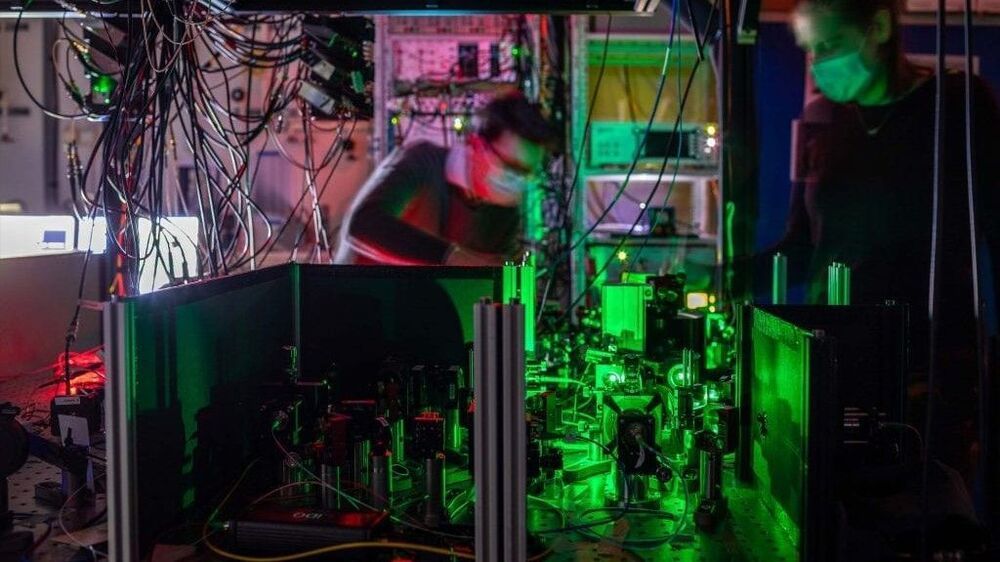
This week, an international collaboration led by Dr. Philip Walther at the University of Vienna took the “classic” concept of reinforcement learning and gave it a quantum spin. They designed a hybrid AI that relies on both quantum and run-of-the-mill classic computing, and showed that—thanks to quantum quirkiness—it could simultaneously screen a handful of different ways to solve a problem.

The result is a reinforcement learning AI that learned over 60 percent faster than its non-quantum-enabled peers. This is one of the first tests that shows adding quantum computing can speed up the actual learning process of an AI agent, the authors explained.

Although only challenged with a “toy problem” in the study, the hybrid AI, once scaled, could impact real-world problems such as building an efficient quantum internet. The setup “could readily be integrated within future large-scale quantum communication networks,” the authors wrote.

/* */