By using a chain of atoms to simulate a black hole’s event horizon, researchers have shown that Hawking radiation may exist just as the late physicist described. Scientists have created a lab-grown black hole analog to test one of Stephen Hawking’s most famous theories — and it behaves just how he predicted.
Astronomers at Caltech have used a machine learning algorithm to classify 1,000 supernovae completely autonomously. The algorithm was applied to data captured by the Zwicky Transient Facility, or ZTF, a sky survey instrument based at Caltech’s Palomar Observatory.
“We needed a helping hand, and we knew that once we trained our computers to do the job, they would take a big load off our backs,” says Christoffer Fremling, a staff astronomer at Caltech and the mastermind behind the new algorithm, dubbed SNIascore. “SNIascore classified its first supernova in April 2021, and, a year and a half later, we are hitting a nice milestone of 1,000 supernovae.”
ZTF scans the night skies every night to look for changes called transient events. This includes everything from moving asteroids to black holes that have just eaten stars to exploding stars known as supernovae. ZTF sends out hundreds of thousands of alerts a night to astronomers around the world, notifying them of these transient events. The astronomers then use other telescopes to follow up and investigate the nature of the changing objects. So far, ZTF data have led to the discovery of thousands of supernovae.
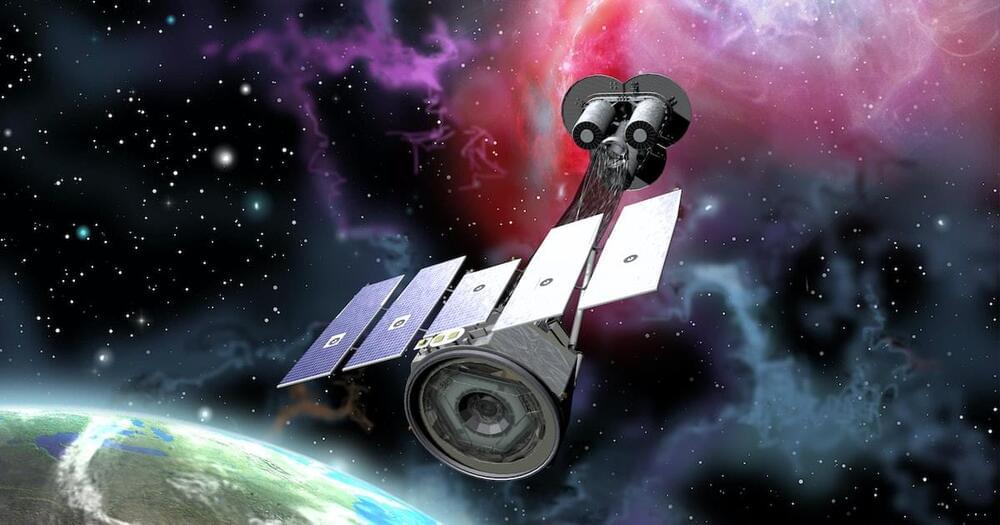
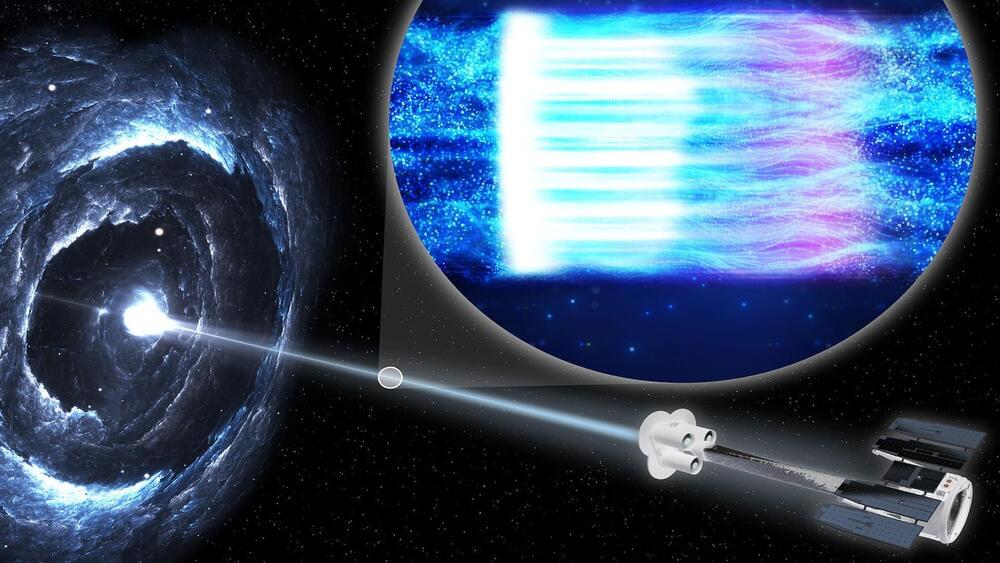
NASA’s Imaging X-ray Polarimetry Explorer allowed scientists to probe a distant blazar, shedding new light on the cosmic giants.
Scientists made observations of bright, shining jets of particles shooting out of a supermassive black hole and they published their findings in a paper in Nature.
Investigating a blazar with state-of-the-art instruments.
Pablo Garcia (NASA/MSFC)
The observations shed new light on the high-energy mechanisms of black holes and will help to improve existing computer models of the cosmic giants at the center of most of the galaxies in the observable universe. They also shed new light on the energy mechanisms of blazars, some of the most mysterious objects in the cosmos.
Astronomers have discovered a tiny black hole relatively near to Earth. It has been dubbed ‘The Unicorn‘and has a mass around three times that of the Sun. The smallest black holes to have previously been discovered are at least six times the mass of the Sun, so the newly found one could fall into a new category.
But do not be fooled by its small size – it still has a gravitational pull which can consume anything around it.
The black hole was discovered by researchers at the Ohio State University, which said it was “hiding in plain sight”.
Get a free month of Curiosity Stream: https://curiositystream.com/isaacarthur. Dark Matter is both the most abundant and most mysterious substance in the Universe, what properties does it have and what technologies might we create to use it in the future?
According to the Standard Model of Particle Physics, the Universe is governed by four fundamental forces: electromagnetism, the weak nuclear force, the strong nuclear force, and gravity. Whereas the first three are described by Quantum Mechanics, gravity is described by Einstein’s Theory of General Relativity. Surprisingly, gravity is the one that presents the biggest challenges to physicists. While the theory accurately describes how gravity works for planets, stars, galaxies, and clusters, it does not apply perfectly at all scales.
While General Relativity has been validated repeatedly over the past century (starting with the Eddington Eclipse Experiment in 1919), gaps still appear when scientists try to apply it at the quantum scale and to the Universe as a whole. According to a new study led by Simon Fraser University, an international team of researchers tested General Relativity on the largest of scales and concluded that it might need a tweak or two. This method could help scientists to resolve some of the biggest mysteries facing astrophysicists and cosmologists today.
We don’t know very much about our universe. We’re fairly certain it exists, but we don’t know how it got here, how long it’s been here, or how big it is. Heck, we don’t even know if our universe is unique.
Ever since Albert Einstein came up with the theory of relativity and other scientists realized that classical physics and quantum mechanics don’t really line up, we’ve been trying to reconcile those worlds.
Many theoretical physicists believe that bridging the gap between obvious reality (classical physics) and the wacky quantum realm could help us finally understand the true nature of our universe.