Photonics integrates quantum mechanics with light, fostering innovations in quantum computing, secure data transfer, and high-resolution imaging techniques.


The brain is famously plastic: Neurons’ ability to change their behavior in response to new stimuli is what makes learning possible. And even neurons’ response to the same stimuli changes over time—a phenomenon known as representational drift. Yet our day-to-day perception of the world is relatively stable. How so?
Resolving such puzzles matters for future brain-computer interfaces, sensory prostheses and therapies for neurological disease. On a quest for an answer, Rice University scientists have built ultraflexible probes thousands of times thinner than a human hair and used them to track neurons in the visual cortex of mice for 15 consecutive days as the animals viewed thousands of images—from line patterns to pictures of the natural world.
The devices, called nanoelectronic threads (NETs), embed seamlessly with brain tissue, allowing for high-fidelity chronic recordings of brain activity.

A research team from the University of Chemistry and Technology, Prague (UCT Prague) and the Institute of Organic Chemistry and Biochemistry of the Czech Academy of Sciences (IOCB Prague) has created and described a new type of photoswitch. The molecule, a thienyl-based acylhydrazone, undergoes an unprecedented “closed-to-open-shell” transformation, where light converts it into a stable diradical.
While previously published lifetimes of such triplet states are a few milliseconds, this new molecule’s switched state has a half-life of over six hours. This revolutionary innovation opens the way for optimizing catalytic processes, developing new data storage and spintronic devices, and targeted elimination of antibiotic-resistant pathogens. The work is published in the Journal of Materials Chemistry C.
Photoswitches are molecules that change between two states under the influence of light. This new switch is unique because it transitions from a stable, non-magnetic (closed-shell) state to an exceptionally long-lived magnetic (open-shell triplet) state. In this triplet state, two electrons have parallel spins, making the molecule paramagnetic and highly reactive. This state is crucial for many photochemical processes, including the generation of reactive oxygen species.

UNSW engineers have made a significant advance in quantum computing: they created ‘quantum entangled states’—where two separate particles become so deeply linked they no longer behave independently—using the spins of two atomic nuclei. Such states of entanglement are the key resource that gives quantum computers their edge over conventional ones.
The research is published in the journal Science, and is an important step toward building large-scale quantum computers—one of the most exciting scientific and technological challenges of the 21st century.
Lead author Dr. Holly Stemp says the achievement unlocks the potential to build the future microchips needed for quantum computing using existing technology and manufacturing processes.

Spintronics devices will be key to realizing faster and more energy-efficient computers. To give us a better understanding of how to make them, a Kobe University team now showed how different manufacturing techniques influence the material properties of a key component.
Electronic devices could be made more efficient and faster if electrons could carry more information at once. This is the basic idea behind spintronics, where researchers try to use the electrons’ spin in addition to charge in data storage, processing and sensor devices to significantly improve our computers.
One component for such devices is the “magnetic tunnel junction,” which may be used, for example, for neuron-like behavior in information processing or in a new type of fast and non-volatile memory. They consist of two ferromagnets, usually a nickel-iron alloy, sandwiching a thin insulating layer such as graphene.
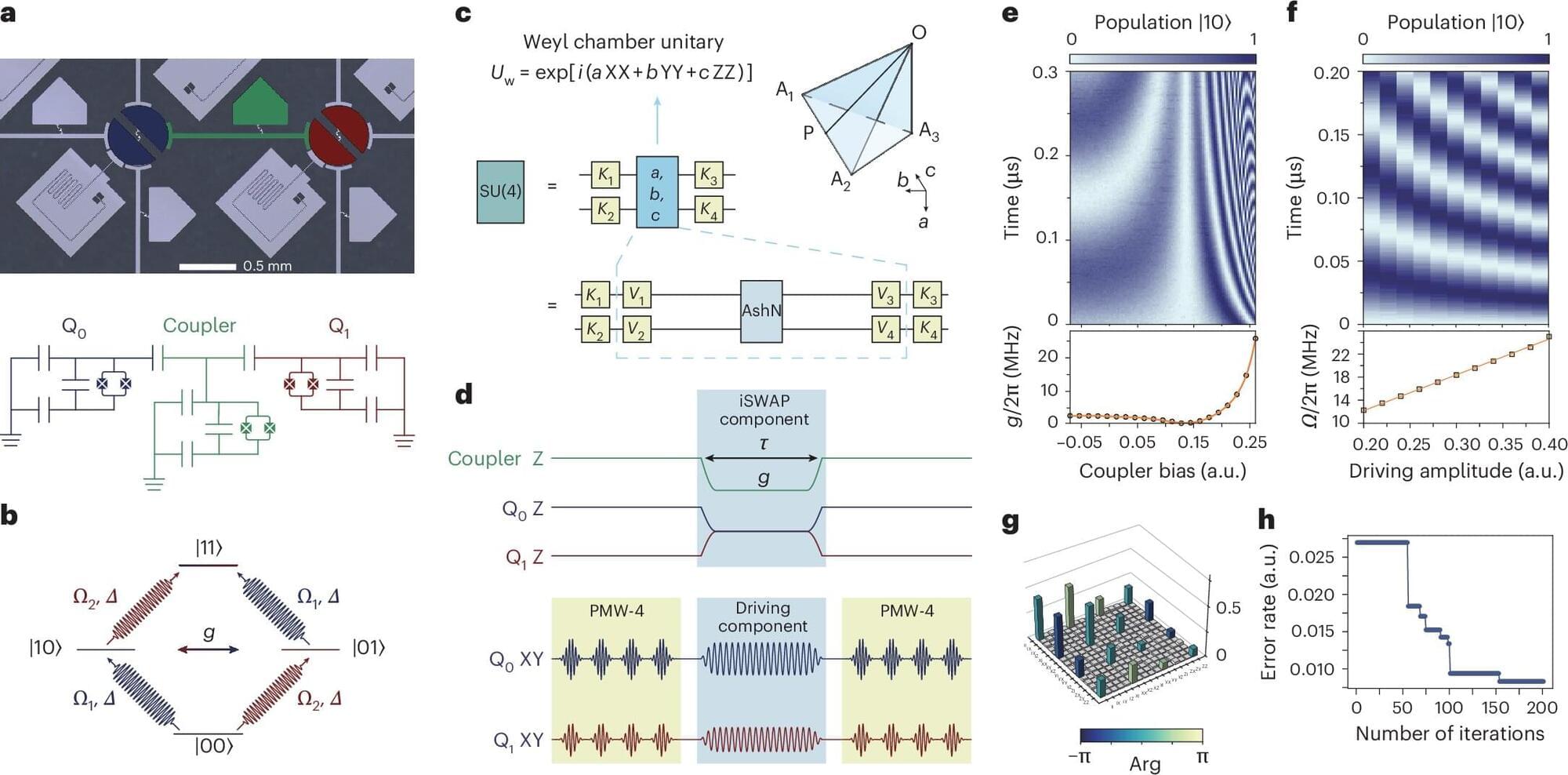
The operation of quantum computers, systems that process information leveraging quantum mechanical effects, relies on the implementation of quantum logic gates. These are essentially operations that manipulate qubits, units of information that can exist in a superposition of states and can become entangled.
A type of quantum logic gate that enables the entanglement between qubits is a so-called two-qubit gate. Notably, most existing schemes for generating these gates force qubits outside of the conditions or parameters in which they can best store information and are easier to control.
Researchers at the Beijing Academy of Quantum Information Sciences (BAQIS) and Tsinghua University recently introduced a new universal scheme to implement two-qubit gates in superconducting quantum processors. This scheme, outlined in a paper published in Nature Physics, was found to reliably enable the generation of entanglement between qubits in superconductor-based quantum computers.

Quantum computing promises to solve the seemingly unsolvable in fields such as physics, medicine, cryptography and more.
But as the race to develop the first large-scale, error-free commercial device heats up, it begs the question: how can we check that these ‘impossible’ solutions are correct?
A new Swinburne study is tackling this paradox. The paper is published in the journal Quantum Science and Technology.
A UK startup has made a revolutionary advancement after delivering the world’s first full-stack quantum computer, built using the same silicon chip technology found in smartphones and laptops.
London-based Quantum Motion, a quantum computing startup that develops scalable quantum computing tech using silicon, launched the industry’s first full-stack quantum computer made with silicon. It was deployed at the UK National Quantum Computing Centre (NQCC).

Black phosphorus nanoribbons (BPNRs), thin and narrow ribbon-like strips of black phosphorus, are known to exhibit highly advantageous electronic properties, including a tunable bandgap. This essentially means that the energy difference between the region where electrons are bound together (i.e., valence band) and that where electrons move freely (i.e., conduction band) can be easily controlled by adjusting the width of the nanoribbons.
A tunable bandgap is essential for the development of transistors, the components that control the flow of electrical current through electronic devices.
While several past studies have highlighted the promise of BPNRs for the development of electronics, strategies that could enable their reliable fabrication on a large scale are still lacking.

Quantum computing, an approach to deriving information that leverages quantum mechanical effects, relies on qubits, quantum units of information that can exist in superpositions of states. To effectively perform quantum computing, engineers and physicists need to be able to measure the state of qubits efficiently.
In quantum computers based on superconducting materials, qubits are indirectly measured by a so-called readout resonator, a circuit that responds differently based on the state of a qubit. This circuit’s responses are probed using a weak electromagnetic wave, which needs to be amplified to enable its detection.
To amplify these signals, also known as microwave tones, quantum technology engineers rely on devices known as amplifiers. Existing amplifiers, however, have notable limitations. Conventional amplifiers can send unwanted noise back to the qubit, disturbing its state. Superconducting parametric amplifiers introduced more recently can be very efficient, but they conventionally rely on bulky and magnetic hardware components that control the direction of signal and protect qubits from backaction noise.