Toggle light / dark theme

3D printed microfluidic lab-on-a-chip device for fiber-based dual beam optical manipulation

Year 2021 face_with_colon_three


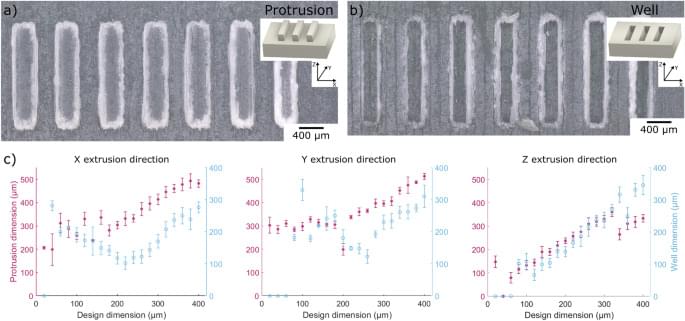
Scientific Reports — 3D printed microfluidic lab-on-a-chip device for fiber-based dual beam optical manipulation. The final 3D printed chip offers three key features, such as an optimized fiber channel design for precise alignment of optical fibers, an optically clear window to visualize the trapping region, and a sample channel which facilitates hydrodynamic focusing of samples. A square zig–zag structure incorporated in the sample channel increases the number of particles at the trapping site and focuses the cells and particles during experiments when operating the chip at low Reynolds number. To evaluate the performance of the device for optical manipulation, we implemented on-chip, fiber-based optical trapping of different-sized microscopic particles and performed trap stiffness measurements. In addition, optical stretching of MCF-7 cells was successfully accomplished for the purpose of studying the effects of a cytochalasin metabolite, pyrichalasin H, on cell elasticity. We observed distinct changes in the deformability of single cells treated with pyrichalasin H compared to untreated cells. These results demonstrate that 3D printed microfluidic lab-on-a-chip devices offer a cost-effective and customizable platform for applications in optical manipulation.

Neuralink Competitor Restores Vision in Blind Patients With Eye Implant

Science Corporation, a biotech startup launched by a Neuralink cofounder, claims that it’s achieved a breakthrough in brain-computer interface technology that can help patients with severe vision loss.

In preliminary clinical trials, legally blind patients who had lost their central vision received the company’s retina implants, which restored their eyesight and even allowed them to read books and recognize faces, the startup announced last week.

“To my knowledge, this is the first time that restoration of the ability to fluently read has ever been definitively shown in blind patients,” CEO Max Hodak, who was president of Neuralink before founding Science Corp, said in a statement.

IBM Launches Its Most Advanced Quantum Computers, Fueling New Scientific Value and Progress towards Quantum Advantage

YORKTOWN HEIGHTS, N.Y., Nov. 13, 2024 /PRNewswire/ — Today at its inaugural IBM Quantum Developer Conference, IBM (NYSE: IBM) announced quantum hardware and software advancements to execute complex algorithms on IBM quantum computers with record levels of scale, speed, and accuracy.

IBM Quantum Heron, the company’s most performant quantum processor to-date and available in IBM’s global quantum data centers, can now leverage Qiskit to accurately run certain classes of quantum circuits with up to 5,000 two-qubit gate operations. Users can now use these capabilities to expand explorations in how quantum computers can tackle scientific problems across materials, chemistry, life sciences, high-energy physics, and more.

Researchers demonstrate universal control of a quantum dot-based system with four singlet-triplet qubits

Being able to precisely manipulate interacting spins in quantum systems is of key importance for the development of reliable and highly performing quantum computers. This has proven to be particularly challenging for nanoscale systems with many spins that are based on quantum dots (i.e., tiny semiconductor devices).

Software package can bypass CPU for more efficient computing

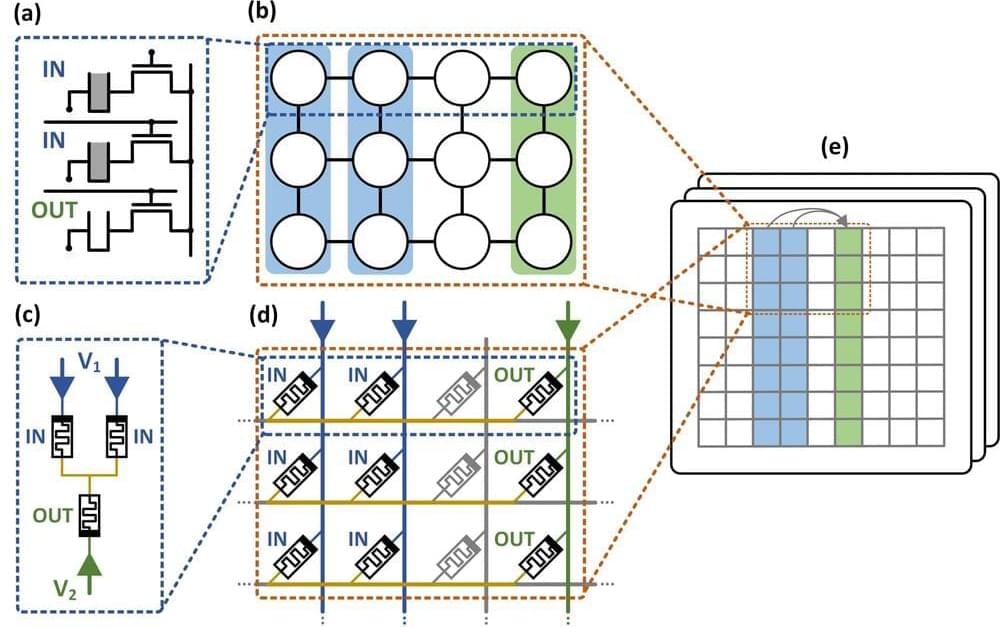
Technion Researchers have developed a software package that enables computers to perform processing operations directly in memory, bypassing the CPU. This is a significant step toward developing computers that perform calculations in memory, avoiding time-consuming and energy-intensive data transfers between hardware components.

A new and exciting field has emerged in the hardware domain in recent years: in-memory computing. The in-memory computing approach introduces a significant change from the way computers typically operate.

While traditionally the CPU runs calculations based on information stored in the computer’s memory, with this innovative approach, some operations are performed directly within the memory, reducing data transfers between the memory and the CPU.As transferring data between computer units is time-and energy-intensive, this change leads to significant savings in both.

People with psychopathic traits fail to learn from painful outcomes

A recent study published in Communications Psychology reveals that individuals with higher psychopathic traits show reduced sensitivity to pain, which affects their ability to learn from painful consequences. The researchers found that people with elevated psychopathic traits tend to revert quickly to initial beliefs after experiencing pain. This new insight could help us understand why individuals with these traits often struggle to adapt their behavior despite negative consequences.

People with psychopathic traits frequently ignore the negative consequences of their actions, likely due to differences in how they process punishment. Past studies have indicated that psychopathy is associated with both an insensitivity to punishment and an excessive drive toward reward, but this study aimed to explore the computational learning processes specifically related to pain. Pain can serve as a powerful teaching signal, so understanding how reduced pain sensitivity influences learning in people with psychopathic traits could shed light on the mechanisms behind their often harmful decision-making.

“One of the hallmarks of psychopathy is aggressive, exploitative behavior with little regard for the wellbeing of others,” said study author Dimana Atanassova, a postdoctoral researcher at the Donders Institute for Brain, Cognition and Behaviour at Radboud University.

/* */