
OutFront
Pills for Everyone!
Robert Langreth, 04.12.04
Lipitor could prevent hundreds of thousands of heart attacks and heart
deaths if more people used it. But who is going to pay for it?
It began simply as another round of one-upmanship in the drug
industry. Lipitor is the bestselling drug in the world, racking up $9 billion a
year for its potent powers to lower dangerous levels of cholesterol and
neutralize the risks of life on cheeseburgers. The Pfizer statin drug is
a ready target, and Bristol-Myers Squibb took aim four years ago, setting up a
face-off to prove its rival statin, Pravachol, with $2.8 billion in sales, was
every bit as good.
Lipitor kicked butt,
researchers unveiled last month. But what was great news for (nyse: PFE
- news
- people
)Pfizer and Lipitor could send shivers through the ranks of employers,
insurers and millions of consumers themselves. The biggest implication of the
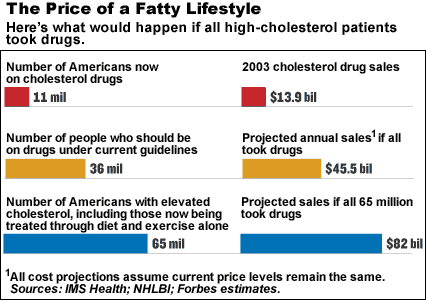
new study is that Lipitor and other statins, now taken by 11 million Americans
at a cost of almost $14 billion a year, might also benefit tens of millions more
patients than doctors had ever expected. This could prevent hundreds of
thousands of heart attacks annually--yet it would add tens of billions of
dollars to the nation's already-bloated bill for prescription drugs. "The
implications are huge, absolutely huge," says Harvard Medical School's
Christopher Cannon, who led the Lipitor-versus-Pravachol study. The results
suggest "we are being far too casual about lowering cholesterol," he adds.
Upside: "It will reinvigorate the entire market."
The Bristol-Myers-financed study basically shows more is
better: Give current patients higher doses of statins than before and their
cholesterol levels will fall even more, further reducing the number of heart
attacks. But that also means millions of Americans previously regarded as having
safe levels of artery-clogging cholesterol (those with a rating lower than 130)
might benefit handsomely, too, from the pricey drugs. Indeed, everyone
over age 55--some 60 million people in the U.S.--would benefit from statins,
argues Nicholas Wald, an epidemiologist at the University of London. He says
over 80% of heart attacks could be prevented if people took a six-drug superpill
containing a statin, low-dose aspirin and a few blood-pressure medicines.
"Initially the reaction was very mixed," when he first argued this last year,
Wald says. "But now the attitudes are changing."
That begs the question: Who will pay for these drugs? Employers
and insurers will have to weigh the great expense of feeding statins to "the
rest of us"--at a cost of up to $120 a month per patient--against the promised
savings of preventing heart attacks. Coronary heart disease afflicts 13 million
Americans, costing $133 billion a year in care. "Cost is the biggest question
right now. Unless the pharmaceutical companies exhibit some mercy ... we have a
very serious problem," says Cleveland Clinic cardiologist Eric Topol. Even
before the study, government guidelines said 36 million people (those with
cholesterol levels of 130 to 160 or more plus other risk factors) should be on
statins. That is about three times the current number, but millions balk at the
cost. "When I say to patients they need to take a statin, they say, ‘I can't
afford $1,000 a year.' My mother-in-law won't take a statin because of the
cost," Topol says.
When Bristol launched
the face-off, it pitted a less-potent Pravachol pill against the highest-dose
Lipitor pill, aiming to show that higher doses didn't have much additional
effect. That backfired. In the study that spent two years tracking 4,162
patients who had already survived a severe heart attack, those on high-dose
Lipitor were 16% less likely to die or have heart attacks than those on
standard-dose Pravachol. That embarrassed Bristol and astounded doctors.
The immediate impact is on patients who just had
heart attacks. Previously, doctors sought to get their cholesterol down to 100
(milligrams per deciliter of blood), but the new study shows significant benefit
in aiming as low as 62. Later, this lower-is-better paradigm could trickle down
to the far broader swath of healthy Americans at risk of heart disease because
of high cholesterol levels. "The next question is: Should we all be at 62?" says
John LaRosa, president of SUNY Downstate Medical Center. If so, millions of
healthy Americans now focusing on a better diet and more exercise might need to
start popping pills.
The pressure--and the
one-upmanship--could rise in the next two years. The lower-is-better concept may
boost Vytorin, a cholesterol combo-pill from Schering-Plough and Merck that
could be approved this summer (FORBES, Mar. 15, 2004); a 788-person study
showed that it reduced bad cholesterol up to 59% versus 53% for Lipitor.Pfizer,
with patent protection for Lipitor until 2010, is conducting a study aiming to
prove high-dose Lipitor saves more lives than Zocor, from Merck. It also is
spending a reported $1 billion testing a new combination of Lipitor with a drug
that raises "good" cholesterol (HDL, versus "bad" LDL); the combo could keep
prices high through 2020. And AstraZeneca's recently approved statin, Crestor,
could swell the market by another 30 million people in 2007, when it expects to
complete a 15,000-person study that aims to prove Crestor prevents heart attacks
in people with normal cholesterol but who are at high risk due to inflamed
arteries.
Most cardiologists say far more patients should get on statins,
which are among the most cost-effective treatments in medicine. "It's one of the
best values in health care," says Harvard's Cannon. "Plenty of things in
medicine cost a lot and the benefit is questionable. Here there is no question
about the benefit, and the cost is moderate." But how far should this go?
Lipitor costs $750 to $1,150 per year. In one study, doctors treated 5,168
high-risk blood pressure patients with Lipitor for three years to prevent 54
heart attacks and deaths. In the real world, that's about $240,000 in drug
spending per heart attack or death averted.
The cost crunch could be eased when both Pravachol and Zocor
lose patent protection and go generic in two years, their prices plunging by
70%. But neither drug lowers cholesterol as much as Lipitor, Crestor or Vytorin.
Employers--and the Medicare system, which is gearing up to cover 35 million
elderly people in 2006--will have to decide whether to pay a big premium to
lower cholesterol by a few extra points, or just push most people toward cheap
generics.
But Pfizer Vice President Gary
Palmer counters:"A generic may be able to lower your cholesterol, but we already
know that if the generic were Pravachol, you'd be better off taking Lipitor."
Therein lies the problem in applying rational economics to the emotion of
medicine: Often the case for less seems clear-cut--until the patient you are
treating is, say, your mom.
Matt Herper
contributed to this article.